


and whatever is said
in the world, or forgotten,
or not said, makes a form.The choice is simply,
I will—as mind is a finger,
pointing, as wonder
a place to be.
— Robert Creeley, from The Finger
There is a great deal of writing online about waking up. Few write about the descent. After awakening, personal work continues. For someone who no longer operates with self-reference at all, which I’d call realization, the conditioned material still renders but no longer registers as a problem. Most of us are not there yet. For most, awakening is not the end of the path but a reorientation. The view has changed, but the old material is still in the system.
It can be heartbreaking to feel utterly open, no longer scanning for threat, and then realize how deeply our roots are still tangled in escape and hurt. Survival strategies don't unwind just because we've seen their hollow core. Disowned parts reintegrate through sustained, embodied willingness to feel what we once refused. Confusing openness with the integration work that follows is one of the more common challenges. It produces people who can speak fluently about non-duality while still hiring everyone around them to carry their disowned vulnerabilities.
Scroll any meditation subreddit, and you'll find a frenzy of practitioners willing to validate or, sometimes cruelly, invalidate one another's numinous experience. Anyone who has experienced dazzling transpersonal radiance, infinitude, boundless love, or the full bloom of the ordinary knows the question that follows. Was the opening genuine? The materialist habit is to dismiss anecdote, and there is no objective source of confirmation. The question quickly runs aground.
A guiding model is that open awareness interrupts self‑absorption. As awareness becomes as familiar and real as self‑absorption, it gradually pervades it, until self‑absorption becomes unsustainable and collapses. Sometimes the collapse is for a moment, sometimes for a lifetime.
I was 21, and I sat on a cliff overlooking the Pacific Ocean...
My senses reveled in the delicate confluence of waves, clouds, and the fragrant ocean breeze. I was transported by the elemental interplay, settling into a relaxed alertness charged with insight. The transmission had an alien quality: ‘it’s not what you think’. This simple slogan carried dramatic impact, my young mind steeped in cultural formulas and anesthetized cynicism.
Any sense of being an entity distinct from wind, waves, grass, and sky collapsed. The envelope of self-reference unwound, and I ‘saw’ the wind working in concert with the ocean in a symphony of symmetry. I was wholly available to the world.
Hui-Neng’s flag koan ‘Not the wind, not the flag; the mind is moving’ unfurled and was settled on the spot.
Another ambient utterance breezily suggested ‘you are it,’ which seemed just fine, because at that moment, I was everything. There was infinite nothing indivisibly woven with colorful, alluring, and spontaneous appearances. The notion that I was a discrete and problematic person melted, and the world oozed a profound simplicity. Two decades of tension uncoiled, sparking flowing tears and rapturous laughter.
In a scant few minutes, my life was turned inside out. The DNA of self-reference unraveled, and my protective fictions rendered transparent.
I hadn’t thought about that morning in years until Oshan Jarrow asked me about ‘oh shit’ moments for his Pivot Points podcast.

Reentry was a messy process. I had no training, no teacher, no map, and little capacity to integrate what had happened. Experiencing groundlessness felt unsustainable.
In my effort to put the pieces back together, I reverse-engineered habitual closure. Choosing inaccuracy over sanity was my boyish effort to zip back into my cocoon. The hallucinatory sense of agency and cultural membership was seductive—and for a 21-year-old, a symptom of health.
Barry Smith—if we can speak of such a person in such a state—could not long bear such a cosmic perspective, where endless waves of time flooded him with trillions of bits of experience and linear time was replaced by meaningfulness in an Everything All at Once. He certainly understood that his humanity 'was immaterial to the cosmic everything that has always been, and shall always continue to be so.' [...] Smith could no longer bear his nonlocal Superman Self that was everywhere all at once. He needed his Clark Kent ordinariness back. He wanted his precious finitude, the sense, even if illusory, that he was not everything everywhere always. - Jeffrey Kripal, Mutants and Mystics
For the next several years I worked through Campbell, Suzuki, Jung, Wilber, Zimmer, Kabat-Zinn, Hillman, the Mind & Life transcripts. Eventually I moved into the Vajrayāna philosophical literature and intensive practice. I was ravenous. Learning lexicons was intoxicating, but eventually I realized I was substituting description for experience.
Study was a brittle replacement for what had happened at the ocean, but it reinstated a self-referential center as the organizing principle. It’s funny to think that I was unconsciously trying to credential myself for a return to free fall.
What happened on the cliff was spontaneous: an awakening out of absorption in personal drama. That is the first stage, and it is the one people often write about. The subsequent steps grind forward and are usually less dramatic. Habitual patterns usually return, and even if the sense of separate self collapses entirely, our circumstances and habits will still be there. What changes is our relationship to them.
The behavioral residue is the marker. If the people around a practitioner are still being harmed by unresolved reenactment behaviors, the fruitional recognition has not yet been integrated developmentally. If we are going to live in society, if we are going to be parents, partners, teachers, or people who hope to be of any use, developmental work is not optional. The people we live with experience our behavior—not our spiritual attainments.
Each moment is interpreted by the shape of learned reactions, cultural conditioning, emotional associations built through years of repetition, and neurological memory that predicts what is safe or threatening. We may wake up, but that doesn’t mean we spontaneously become skillful. We don’t suddenly speak French or know how to design spaceships. We don’t suddenly know how to have satisfying relationships.
Experiencing the relational field as empty of essential nature does not relieve us of the obligation to act like an adult. Fruitional experience and developmental capacity often advance independently. Non-conceptual experience can stabilize, transmission capacity can be real, and attainment can be genuine, while moral self-authorship remains at the cultural baseline. Realization doesn’t retroactively audit the entitlements we inherit.

Many of us have been locked in orbit by someone whose gravitational pull is powered by bypass. I recently experienced this pattern up close: practice that was genuine and conduct that was consistently at odds with it. In the classroom, there was practical transmission; outside it, a steady pattern of overreach, reframing, and entitlement. Spiritual path language was used as a deflection. Boundary violations got reframed as misunderstandings. Unilateral decisions were recast as generosity. Professional limits got met with appeals to love and connection, as though insisting on adult agreements is a form of hostility.
What struck me was how seamlessly awakening and entitlement operated side by side. I had to admit I had abandoned myself in the presence of spiritual credentials I respected. When I stopped taking my own experience seriously, theirs started to feel more real than mine. This is one shape of spiritual bypass—not only the teacher’s, but mine too.
If you find yourself in this kind of bind, pull the location of disturbance back to yourself. Not: are they right, are they unethical, are the credentials real. Instead: what am I experiencing right now that I am trying to escape from? Then it becomes possible to respond rather than react, instead of treating someone else’s experience as more real than our own.
What the Vajrayāna traditions espouse, and what the contemporary meditation scene underplays, is that the descent is the longer and more interesting part of the path. Tantra does not engineer ideal conditions for awakening. There is no controlled environment, no fragile attainment to protect.
The path works with friction, interruption, the texture of unconditional participation in experience. Obstacles are a treasured medium. The well-rounded practitioner cultivates competence across a range of disciplines: dharma, medicine, astrology, art, writing, ritual.
Each domain puts a different kind of pressure on the path work, exposing a different layer of what we have been organizing our lives not to feel. Personal work makes it harder to blame circumstance. Interpersonal work makes it harder to blame other people. And the longer you spend in spiritual practice, the thinner the fantasy that some future enlightenment will sort everything out. Competence across disciplines is not only a matter of craftsmanship. It is an opportunity to stay in contact with enough varieties of friction that our avoidance strategies can no longer escape notice.
The metaphor I keep coming back to is making music. There is the pregnant silence, and there is the articulation of a note: its attack, register, and release. For practitioners of the absorptive paths, samādhis develop an unbound interiority that prioritizes inner experience. The encounter is one of fullness without object: ‘I am nothing’. The practitioner has stopped being armored by distraction, and the absence of defensive structures feels like a homecoming.
The Tantric ideal is to recognize appearances as the seamless expression of awareness. A move toward unconditional aliveness: the texture of breath, the weight of a lover’s words, the joy of assembling a meal. The path culminates in ‘I am everything’—the experience of that same awareness stitched into the fabric of ordinary life.
By design, the absorptive paths often do not cultivate the articulation of the note. They face away from appearance. A practitioner who has spent decades practicing jhāna may return to the world to find that playing music has not been getting any easier.
Vajrayāna traditions take the open clarity of awareness for granted as the ground and orient downward and outward from there, into the body, the senses, relationships, occupation, and craft. The methods of the inner tantras use the breath, channels, vital essences, and deities as a way to interpret the body as subtle and effulgent, and to replace out-of-date conceptions of flesh, ideas, and mind.
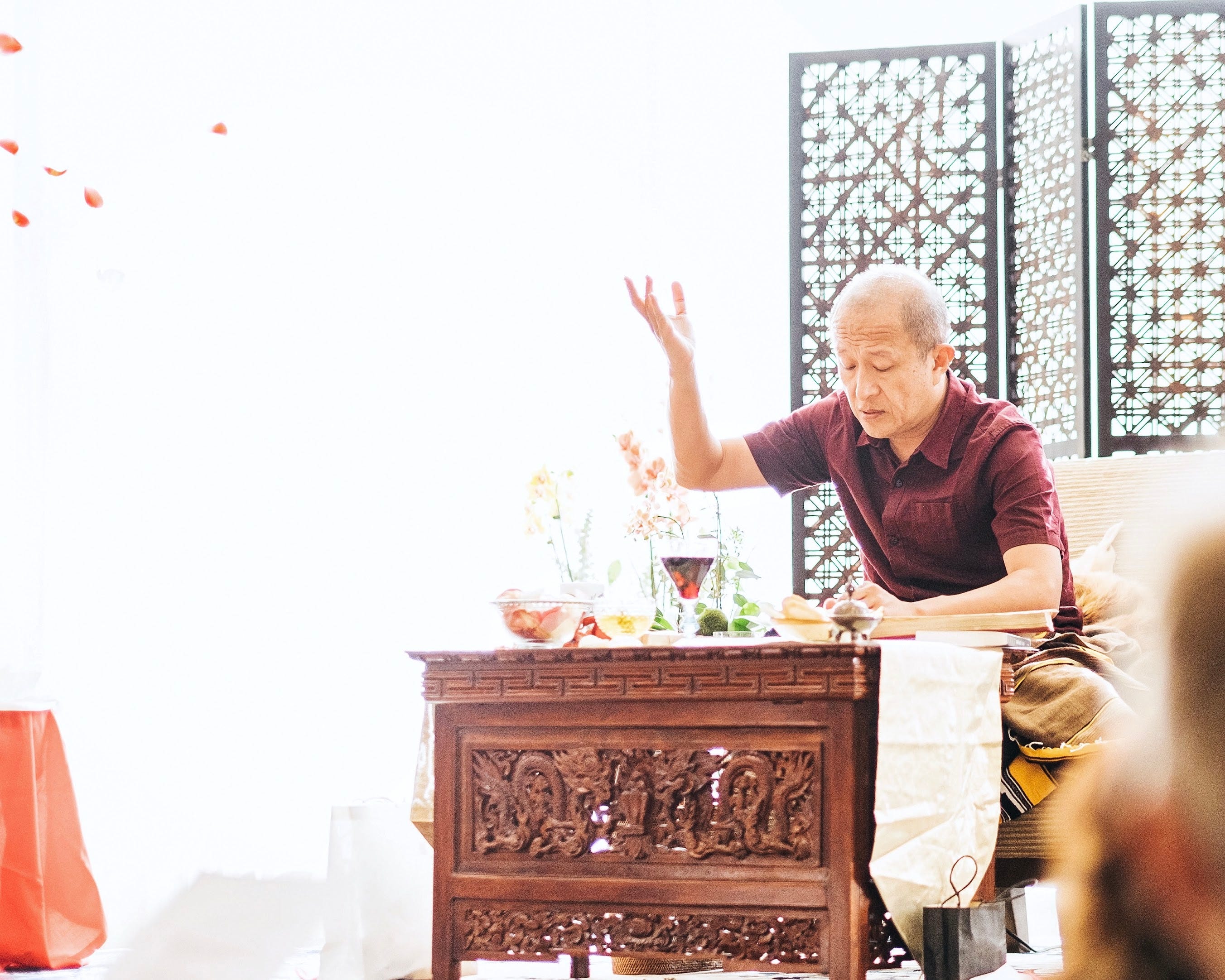
A phrase that intrigues me from the Ādvaita tradition is ‘This is it. This is everything,’ which sounds like a grandiose claim but in practice is a considerably more modest tool. It suggests the practitioner has stopped trying to be defined by the achievement of enlightenment. Nor do they find themselves solely defined by the messy aspects of being human.
Immediate experience can clarify that appearances and awareness are inseparable. At any moment we can lean toward the conventional self, with its preferences and consequences, or rest as an open field, free of reference point. Learning to move between these views, rather than collapse into one formula, is a craft. Reality does not change, but our perspective can.
“For instance, we need to look with our eyes to laugh,” he said, “because only when we look at things can we catch the funny edge of the world. On the other hand, when our eyes see, everything is so equal that nothing is funny.” - Carlos Castaneda
A figure that made a craft of post-awakened living is Jerry Garcia. His own opening came at Olompali Ranch in the sixties: three-hundred-and-sixty-degree vision, dying a few thousand times, the word ‘All’ floating into the sky before he turned into a field of wheat. He came out of it saying he had unravelled every strand of DNA in his body. His cocoon cracked, and it informed his craft.
He did not become the player he was by maintaining critical distance from traditional forms. He submitted to the rigors of the ever-shifting ground of living musical traditions. Bluegrass, folk, jazz, his devotion to the repertoire grew an improvisational style that defined his contribution to the American cultural landscape. He practiced obsessively. He mined traditional structure until new forms emerged.
Discipline requires releasing control, being a novice, sitting with incompetence and confusion, and trusting that practice will guide us into more evolved dimensions of a form. There are modes and changes, licks absorbed from a hundred records, the structural accoutrements of theory, and in the hands of someone like Garcia those left-brain coordinates become transparent inside the playing.
Excellence is what emerges when innate capacity meets sustained practice. The Greeks had a word for this: aretē. Excellence understood as a thing’s nature fully realized through skilled action—the specific fulfillment that emerges when a person is doing what they are equipped to do, with attention, over time. Aretē is the fruit of a sustained descent.
The flow that emerges in that kind of playing is recognizable to anyone who has played in a locked-in ensemble. The individual disappears into the rhythm, the melody, the silence, and the texture of the room. The experience becomes a seamless dimension of play. These flow states extend across disciplines. For some Vajrayāna students, the confluence of yogic posture, breathwork, visualization, and devotion provides deeply gratifying access not only to flow states but also to nondual experience.
Clearly, Garcia had an exceptionally fun and interesting life propelled by his commitment to community, practice, and the joy of making music with others.
What I do is basically a Yoga. It’s a discipline. I think everybody should have a discipline, it can be inward, it can be outward, it doesn’t matter. Whatever your constitution likes. It’s just a matter of having something which you can relate to and say ‘this is for me’, this is me without anything else. This is as far as I have gone along this particular line. If it’s doing pushups or breathing or meditating. It’s something you know. It’s something there’s no bullshitting about. It’s basically real and it’s ... like, having something to relate to that’s basically real is always a good thing. Every person should have something like that. - Jerry Garcia
Garcia was also an addict. He started using heroin in the mid-1970s and struggled with it, on and off, until his death twenty years later. Neither his awakening nor his craftsmanship protected him from normative human struggles. I speculate that wakefulness amplified his sensitivity to his own traumas and inspirations. His commitment to his professional craft did not seem to offer him the relief and anonymity to work through his own inner struggles. He was a human being inside a human nervous system, with everything that comes with it.
The Vajrayāna lineage figures were brewers, hunters, prostitutes, drunks, fishermen, vagabonds, and miscreants. Virūpa drank his way through a tavern and paid the bill by holding the sun in the sky. Tilopa pounded sesame seeds by day and worked as a pimp for a prostitute by night. The mahāsiddhas were not exemplars of moral propriety. Realization arose inside lives that were just as chaotic as our own. The tradition refuses to whitewash the mess. The descent does not deliver us to a perfect life. Our relationship to our human mess is what shifts.

The developmental work is cleaning up the environment of inner experiencing. Not to cure pathology, but to soften the clamor and conflict in order to have more moments of open experience. What is already the case becomes easier to notice. The success we find plying our craft makes us more motivated to refine the foundations. Fundamentals feed each other in an ascending spiral, and a practitioner who has felt this is unlikely to settle for a cerebral or disembodied substitute.
Most of us are not going to be Garcia or Tilopa. The median practitioner is usually doing personal work that has more practical implications: getting better at being a good listener, being less reactive with their kids, taking personal responsibility for their behavior. Ken Wilber’s working standard is adequacy. You do not have to be Shakespeare to use language well, or a mahāsiddha to joyfully participate in life.
Meditation students are craftspeople. We may as well take ownership of that, and do our best work. One aspect of the work is a never-ending oscillation between the fruitional view, where there is nothing to fix, and the texture of relative experience, where there is plenty to investigate and improve.
This is inoculatory medicine, taken in small doses: tolerating openness, inviting formless panic in brief bouts. If it is only one second of awareness, great! The point is to bring our intention to that experience without worrying about how sustained or deep it is, and to do it often. It probably works better than sitting for half an hour trying to achieve openness. Short bouts of practice build the capacity to stay present with the existential intensity that usually launches us into reactivity. The fruits are unglamorous. The real upgrade is becoming less afraid of our own inner life.
We are back to the central Schwartzian theme of the simultaneous reality of form and formlessness, of the finite and the infinite. This is the final lesson of Superman for Alvin Schwartz, and the final lesson of Clark Kent: “The Superman self, as you believed even then, was not something one could live in all the time. It’s a far too heightened level of the personality. Sustaining it for too long could burn one out very quickly, and possibly do the same to those around one.” - Jeffrey Kripal, Mutants and Mystics
Contemporary online spiritual culture might be defined by the engineering of bliss states, the curation of cognitive models, the cataloguing of subtle body taxonomies, and the project of fusing traditions into a master synthesis. These are all fun and worthwhile pursuits. They support inner work, create community, and provide developmental milestones and lexicons. They just won’t give rise to realization. Committing to the inherent limitations of our human experience requires no particular framework or technique. Neither does being kind toward whatever arises in the endlessly fresh stream of immediate experience.
A spiritual formula turns unease into a problem to fix, which is the old neurotic project in camouflage. Avoidance has a predictable cost: when we turn away from raw, exposed feelings, they start to seem too big to face. Our bliss and flow states become fragile, easily unspooled by the smallest challenge. Each attempt to lock in a preferable state deepens the avoidance underneath.
Chasing bliss is an addiction. The pattern of sensing, avoiding, seeking relief, briefly acquiring, and sensing again is a cycle punctuated by moments of temporary release. The cycle reinforces the hallucinatory self and its preferences, which is what we wanted to be free of when we started on the meditative path.
The descending path feels counterintuitive. We stop recoiling from contraction. We move toward our vulnerability and practice being kind to our fears. We end the project of the divided self and recognize that disowned traits are us.
I notice this loop in myself. When aliveness is in the foreground, when sensation is effervescent and the interpretive overlay of self-reference has dimmed, the impulse to cobble together theories diminishes.
When life is chaotic, the impulse to use formulas becomes nearly irresistible. I have a markdown folder full of journaled constructs. Slogans, axioms, theoretical frameworks—these feel like a way to maintain some sense of control when the immediacy of experience feels inaccessible. An effort to re-member.
Spiritual formulas can become scaffolding for a flavor of Stockholm syndrome. We get cozy with familiar settings, conflicts, sensations, thought patterns, and cultural ideas. Then a spiritual experience hits, the walls drop, and we find ourselves exposed: naked, raw.
It helps to step out of the house into the open and still have a tipi to return to. Some practitioners adapt to living outdoors, exposed to the elements full-time. They’ve surrendered the idea that a solid, separate self has value beyond being a transitional instrument. Most of us are not them. The house is a port, not a prison.

I love Grant Morrison’s commentary on post-anomalous experience: “no matter how many fluorescent realms you visit, you still have to come home, take a shit, be able to cook dinner, water the plants and, most importantly, talk to people without scaring them. When you complete any magical work, ground yourself with a good laugh, a good meal, good shag, a run or anything else that connects you with the mundane world.”
Morrison’s irreverence emphasizes the weird and amusing side of life in a register the online spiritual genre sometimes misses. Visionary experience matters less than what happens when you come home.
As Morrison walks us back to the kitchen table, another reflex angles in the opposite direction: the post‑awakening fantasy of being a cosmic savior, commissioned to rehabilitate the world. A project of cosmic significance seems to demand cosmic agency.
I know this pull firsthand. My early awakenings led me into organizations working on nuclear disarmament, ocean conservation, peacekeeping, biodynamic farming. The work was interesting and the people inspiring, and part of the allure was the grand scale. I assumed that because open experience is unlimited and unconditioned, action in the world should be too.
But relative experience is conditioned, finite, and dense with friction. Post-awakening work means acting skillfully within those constraints. The work that’s transformed me most has been close to home with friends and family, where feedback is ongoing and my shortcomings are glaringly visible. None of this is an argument against working on hard, large problems. I only argue against the fantasy that meaningful work should feel unobstructed.
I try to release any drive toward a grand destination and experience each shift as fresh and ungraspable. The interesting question for me is what I am willing to do in the world: what craft I am committed to, what action I will take, and how I can relate to my community and intimates.